Three amino acids, two arrangements
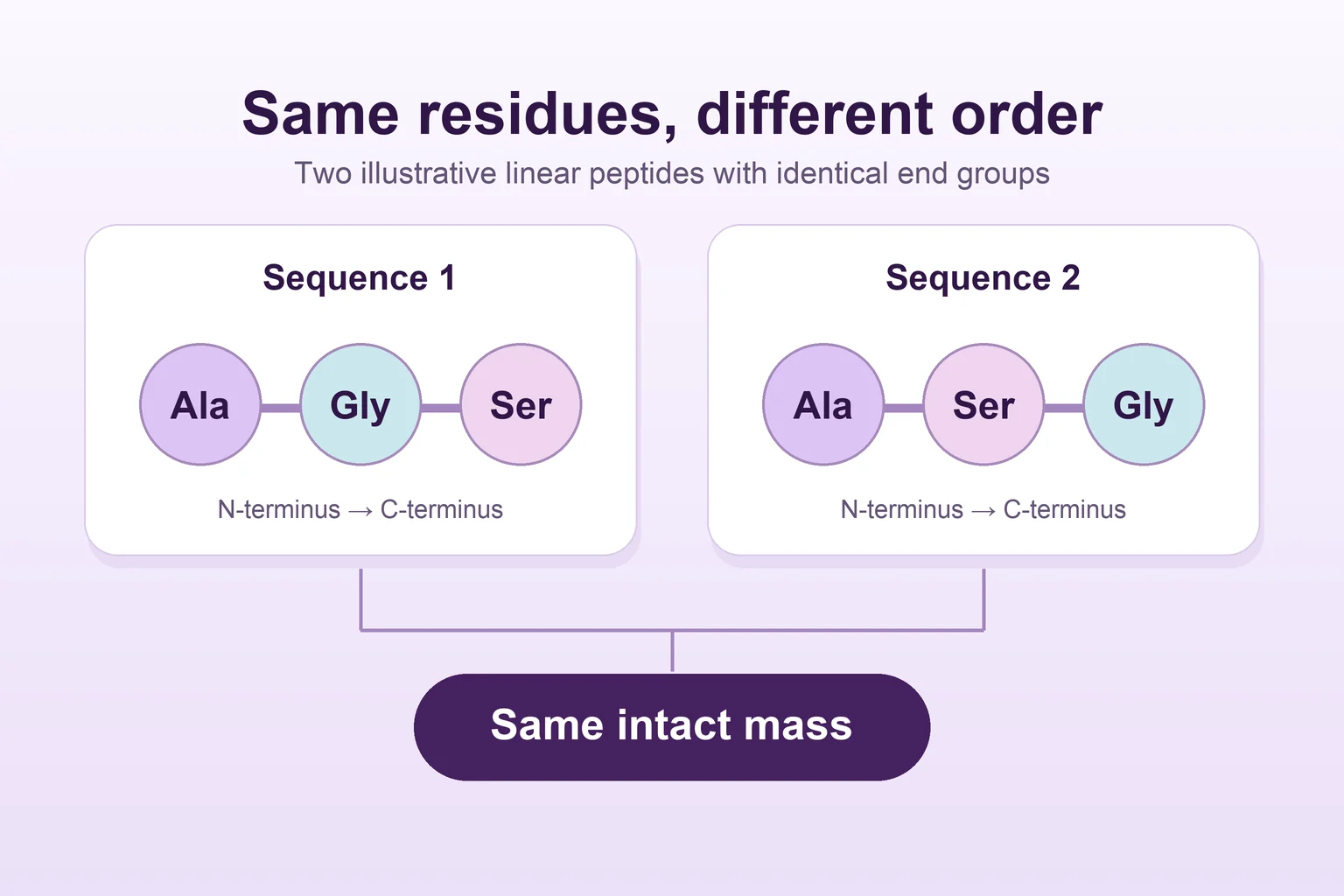
Write Ala–Gly–Ser on one line and Ala–Ser–Gly on another. These simple peptide chains contain the same amino-acid residues in a different order. With matching terminal groups and isotopic composition, they have the same intact mass. Adding more decimal places cannot reveal which order is present. The diagram illustrates this hypothetical comparison.
First, find out what the number represents
A mass spectrum displays ion signals against m/z, which depends on mass and charge state. IUPAC distinguishes a measured accurate mass from an exact mass calculated for a specified isotopic composition. Before interpreting agreement with an expected value, check that the report compares the same ion form and charge. Agreement supports that comparison. Residue order requires evidence that can distinguish possible sequences.
Fragments add a pattern to the total
Tandem mass spectrometry, usually written MS/MS, examines product ions formed from selected precursor ions. Researchers compare a pattern of fragments to learn how the peptide is put together.
NIST’s peptide-library documentation describes reference spectra through both the positions and abundances of fragment-ion signals. Charge state and fragmentation conditions influence which peaks appear. Those details matter when interpreting spectra collected on different instruments.
Return to the two short chains. Their first two residues are Ala–Gly and Ala–Ser, respectively. If each yielded the corresponding two-residue fragment from its amino end, fragments of the same ion type and charge would differ in mass. That difference could help distinguish these two candidates. An actual report would need to show which fragments were observed and how they were assigned.
Some alternatives need more than backbone fragments
Leucine and isoleucine make the problem more subtle. They have the same elemental composition but different side-chain arrangements. A mass match alone cannot distinguish them, and ordinary peptide-backbone fragments can leave that distinction unresolved.
In a 2022 study, Halle Edwards and colleagues examined four model peptides and two naturally occurring peptide sequences using charge transfer dissociation, comparing the resulting spectra with conventional collision-induced dissociation. Their method generated additional fragments involving side chains that helped distinguish leucine from isoleucine. Useful diagnostic fragments were not observed in every instance.
This supports the analytical approach in the tested examples. It does not establish that every MS/MS report resolves every leucine/isoleucine position. Look for evidence addressing the specific alternative, beyond the technique’s name.
One spectrum can have more than one contributor
A tandem spectrum can also contain signals from more than one peptide. Xi Chen and colleagues explored this problem in 2010 using data from two histones and four proteins studied by oxidative footprinting. Their focus included peptides with the same modification at different positions.
They identified evidence of isomeric mixtures in five of the six targets. Accounting for mixtures improved identification results, but did not greatly change the overall identification rate in those datasets. The work therefore supports the existence and analytical importance of mixed spectra without implying that every dataset is dominated by them.
The authors also treated uncertainty explicitly. Their analysis distinguished stronger mixture evidence from possible mixtures and unresolved cases. The useful lesson for a reader is to preserve that distinction: a plausible second contributor and a confidently identified second contributor are different conclusions.
A software match has a reference behind it
An identification printed by software can look like a direct instrument reading. It is the result of a comparison. In their 2007 SpectraST study, Henry Lam and colleagues developed a method that matched measured tandem spectra with previously identified reference spectra. They constructed a library from high-confidence assignments and filtered low-quality or incorrectly identified entries.
The distinction between the measured signal and its assigned name matters. A library match connects a new observation to an existing reference. Reading that claim means asking which library was used, how its entries were established and how confidence in the match was evaluated.
For the two chains in the illustration, ask which observations distinguish the reported assignment from the alternative. The software label gives you a candidate whose supporting evidence you can trace.
An identity claim can draw on several kinds of evidence
Diane McCarthy and colleagues’ 2023 reference-standard paper offers a concrete example. For leuprolide acetate reference material, the authors reported agreement with the expected mass and MS/MS coverage of the sequence, alongside NMR and chromatographic identity evidence. These measurements were parts of a combined characterization.
The paper also cautioned that features such as chiral or isobaric amino acids can require additional techniques. That caveat belongs beside the positive results. Coverage of a sequence and resolution of every possible structural distinction should not be silently treated as equivalent claims.
The authors disclosed that they were employees or collaborators of USP, which develops and sells reference standards. Their observations concern the materials studied. Use the example to read an identity claim, then look to the analytical record for the sample you are assessing.
Write the conclusion at the level of the evidence
Try drafting a one-sentence interpretation before accepting an identity headline. Does the report show agreement with an expected intact mass, a fragment pattern consistent with a proposed sequence, or a comparison that specifically addresses a close alternative? Name the result you can actually point to.
For an EliteGen research document, keep the sample identifier beside that sentence. Then add one precise unresolved question, if needed. You might ask where the sequence assignment is supported, whether a named ambiguity was assessed or which reference was compared. This creates a useful review note without filling gaps from a familiar product name.
Return to the two chains in the illustration. Their matching total is informative. The order question simply asks for another kind of evidence.
Frequently asked questions
Would a more precise intact mass distinguish the two illustrated chains?
No. With the same composition and terminal groups, their calculated intact masses match. Greater mass precision does not encode residue order.
Does MS/MS automatically distinguish leucine from isoleucine?
No. Edwards and colleagues used additional side-chain fragmentation evidence. The report must establish whether its particular method resolves that distinction.
Why use another identity method when the mass agrees?
Different methods address different structural questions. McCarthy and colleagues combined several approaches and noted that some peptide features still require additional characterization.
Sources
- Definitions of terms relating to mass spectrometry (IUPAC Recommendations 2013)IUPAC, Pure and Applied Chemistry · 2013 · DOI: 10.1351/PAC-REC-06-04-06
- NIST Library of Peptide Ion Fragmentation SpectraNational Institute of Standards and Technology · 2008
- Differentiation of leucine and isoleucine residues in peptides using charge transfer dissociation mass spectrometry (CTD-MS)Edwards and colleagues, Rapid Communications in Mass Spectrometry · 2022 · DOI: 10.1002/rcm.9246
- Identification of Tandem Mass Spectra of Mixtures of Isomeric PeptidesChen and colleagues, Journal of Proteome Research · 2010 · DOI: 10.1021/pr100205k
- Development and validation of a spectral library searching method for peptide identification from MS/MSLam and colleagues, Proteomics · 2007 · DOI: 10.1002/pmic.200600625
- Reference Standards to Support Quality of Synthetic Peptide TherapeuticsMcCarthy and colleagues, Pharmaceutical Research · 2023 · DOI: 10.1007/s11095-023-03493-1
Published by EliteGen Research for research education. Studies describe their own materials and experimental conditions; they do not establish the identity, quality, or suitability of an EliteGen product. This article does not provide guidance for personal, human, or veterinary use.