The most useful line in a TB-500 paper
When two papers come up under the same peptide name, the instinct is to put them side by side and compare results. With TB-500, go one line further into the methods. Look for a sequence and a description of the material. You can save yourself a long afternoon comparing papers that began with different molecules.
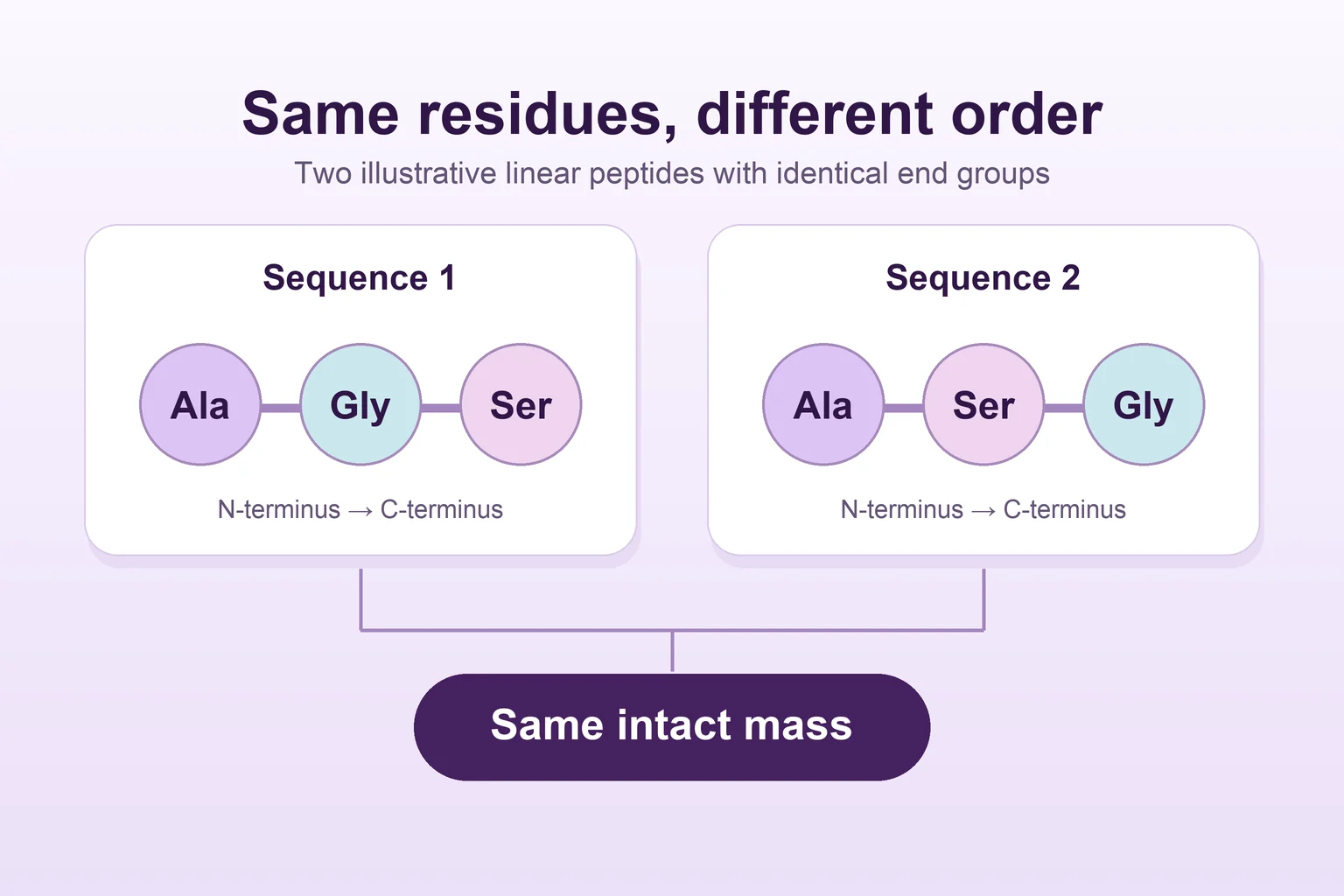
In 2012, Esposito and colleagues identified Ac-LKKTETQ in a material labelled TB-500. Ho and colleagues investigated the same fragment in separate analytical work. The letters describe seven amino-acid residues. “Ac” records an acetyl group on the amino end. Those two extra characters specify a chemical feature, so they belong in a citation note just as much as the sequence does.
Sources: Esposito and colleagues, Drug Testing and Analysis (2012): Synthesis and characterization of the N-terminal acetylated 17-23 fragment of thymosin beta 4 identified in TB-500, a product suspected to possess doping potential · Ho and colleagues, Journal of Chromatography A (2012): Doping control analysis of TB-500, a synthetic version of an active region of thymosin β₄, in equine urine and plasma by liquid chromatography-mass spectrometry
How a reference helps answer an identity question
Esposito’s team used liquid chromatography and high-resolution mass spectrometry to characterize the sampled material. The researchers also synthesized a reference peptide and compared analytical results from the two materials. The work linked the proposed sequence and terminal modification to more than one observation.
A chromatography peak tells you when a component emerged from the column under the conditions used. A mass spectrum adds information about ions associated with the component. Fragment signals can supply clues about the sequence and location of a modification. A reference gives the reader something defined against which to judge the combined observations.
Think of a fictional report that offers one line, “main peak detected,” with a neat figure underneath it. That line gives you a place to start, but leaves the identity question open. Now imagine the report also describes the expected molecule, shows the comparison with a defined reference and explains which signals agree. The value of the second report is in how the conclusion can be checked.
When the question moves from a supplied sample to a biological sample
Ho and colleagues examined the parent fragment and related metabolites in equine urine and plasma. They used an in vitro investigation to consider possible metabolites, then interpreted the biological samples with chromatography and mass spectrometry. Their assignments drew on both retention and the patterns of fragment ions.
Here “parent” means the starting analyte, and “metabolite” refers to a related molecule formed as the material is processed in the biological system. A report can identify the two independently. Knowing which one a figure follows is especially important when a paper’s title uses the name of the original material for the study as a whole.
A useful annotation starts with the question the experiment can answer. “Which analyte was identified in this sample?” is a chemical question. “Which response changed in this system?” needs a different kind of measurement. The paper in front of you might answer the first with considerable detail and leave the second for a completely different study.
Where the seven residues fit in the longer chain
In 1981, Low and colleagues reported a 43-residue sequence for thymosin beta-4 isolated from calf thymus. The material Esposito’s group identified in 2012 corresponded to residues 17 through 23 of human thymosin beta-4, with an acetyl group at the beginning of the fragment. The two papers therefore describe chains of different lengths, from different sources and studied for different purposes.
A fragment can carry letters that also appear in a full-length sequence. The part worth circling in a methods section is the boundary. Which residues are present? What has happened to the ends? Those details can make a big difference to whether two paper summaries belong next to each other. In this case, the seven-residue notation is a much more informative label than a broad family name.
Sources: Low and colleagues, Proceedings of the National Academy of Sciences (1981): Complete amino acid sequence of bovine thymosin beta 4: a thymic hormone that induces terminal deoxynucleotidyl transferase activity in thymocyte populations · Esposito and colleagues, Drug Testing and Analysis (2012): Synthesis and characterization of the N-terminal acetylated 17-23 fragment of thymosin beta 4 identified in TB-500, a product suspected to possess doping potential
A one-line test for a literature comparison
Try summarizing each paper before comparing the results. Write “The authors examined [identified material] in [sample or model] using [measurement].” Then add the specific question the measurement addresses. If you find yourself substituting the name of a compound from the next paper into the first blank, look again at the material description.
Keep the published wording when identity remains ambiguous. For example, a hypothetical entry for a study with incomplete documentation might read “labelled as TB-500, sequence unreported.” That is a more precise statement than guessing which fragment it contains. It also tells the next reader exactly which part of the comparison would benefit from another source.
A publication and a lot record have different subjects
An analytical paper documents the materials its researchers tested. A lot record describes a particular sample. To connect them, check the sample identifier and the stated molecular form before comparing analytical evidence. If a report lists a chromatographic purity figure, find out what method produced it and where the molecular identity is documented.
The EliteGen catalog uses the name TB-500. Treat the catalog label as the starting point for finding the matching documentation. The 2012 results identify what was found in the authors’ study materials. A separate lot needs a record that is traceable to the sample under review.
Frequently asked questions
Is Ac-LKKTETQ the same molecule as full-length thymosin beta-4?
Ac-LKKTETQ denotes a seven-residue fragment with an acetyl group on its amino end. Full-length thymosin beta-4 contains 43 residues in the foundational sequence report. A region can occur in both molecules while the complete chains remain distinct.
Sources: Esposito and colleagues, Drug Testing and Analysis (2012): Synthesis and characterization of the N-terminal acetylated 17-23 fragment of thymosin beta 4 identified in TB-500, a product suspected to possess doping potential · Low and colleagues, Proceedings of the National Academy of Sciences (1981): Complete amino acid sequence of bovine thymosin beta 4: a thymic hormone that induces terminal deoxynucleotidyl transferase activity in thymocyte populations
Why does a paper refer to both the parent peptide and its metabolites?
The terms distinguish the starting analyte from related molecules formed as a biological system processes it. In Ho’s equine analytical study, the researchers tracked these as distinct species. Check the figure labels to see which species a reported peak represents.
What if a paper gives a peptide name but no sequence?
Record the name as written and mark the sequence as unreported in the materials you reviewed. The supplement or an accompanying analytical record may provide additional detail. Until then, keep the identity question open when comparing that study to a sequence-defined fragment.
Can the 2012 papers verify the identity of a lot today?
Their results apply to the materials they examined. To assess a current lot, look for the stated sequence or molecular form and analytical documentation tied to that lot number.
Sources: Esposito and colleagues, Drug Testing and Analysis (2012): Synthesis and characterization of the N-terminal acetylated 17-23 fragment of thymosin beta 4 identified in TB-500, a product suspected to possess doping potential · Ho and colleagues, Journal of Chromatography A (2012): Doping control analysis of TB-500, a synthetic version of an active region of thymosin β₄, in equine urine and plasma by liquid chromatography-mass spectrometry
Sources
- Synthesis and characterization of the N-terminal acetylated 17-23 fragment of thymosin beta 4 identified in TB-500, a product suspected to possess doping potentialEsposito and colleagues, Drug Testing and Analysis · 2012 · DOI: 10.1002/dta.1402
- Doping control analysis of TB-500, a synthetic version of an active region of thymosin β₄, in equine urine and plasma by liquid chromatography-mass spectrometryHo and colleagues, Journal of Chromatography A · 2012 · DOI: 10.1016/j.chroma.2012.09.043
- Complete amino acid sequence of bovine thymosin beta 4: a thymic hormone that induces terminal deoxynucleotidyl transferase activity in thymocyte populationsLow and colleagues, Proceedings of the National Academy of Sciences · 1981 · DOI: 10.1073/pnas.78.2.1162
Published by EliteGen Research for research education. Studies describe their own materials and experimental conditions; they do not establish the identity, quality, or suitability of an EliteGen product. This article does not provide guidance for personal, human, or veterinary use.