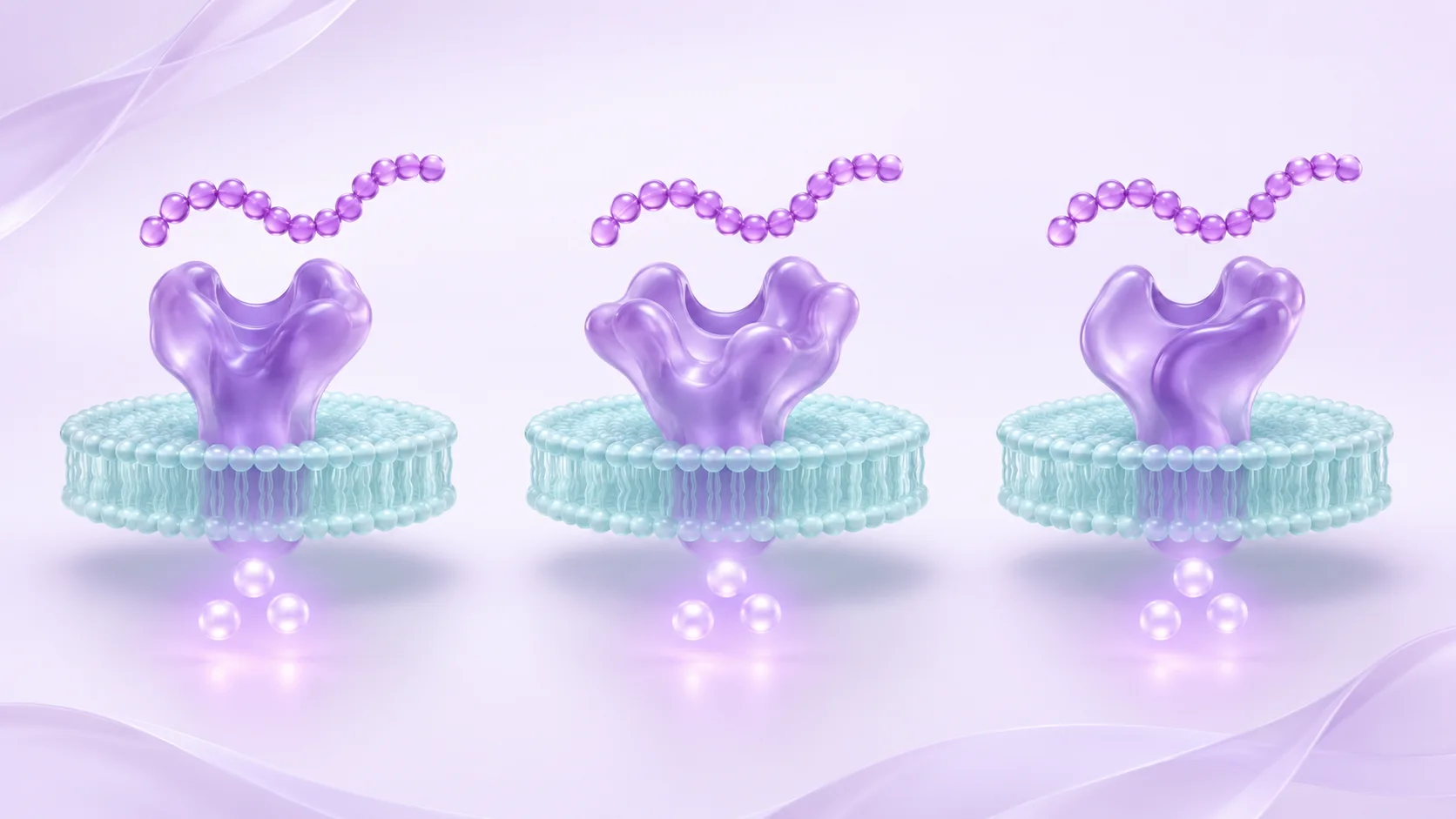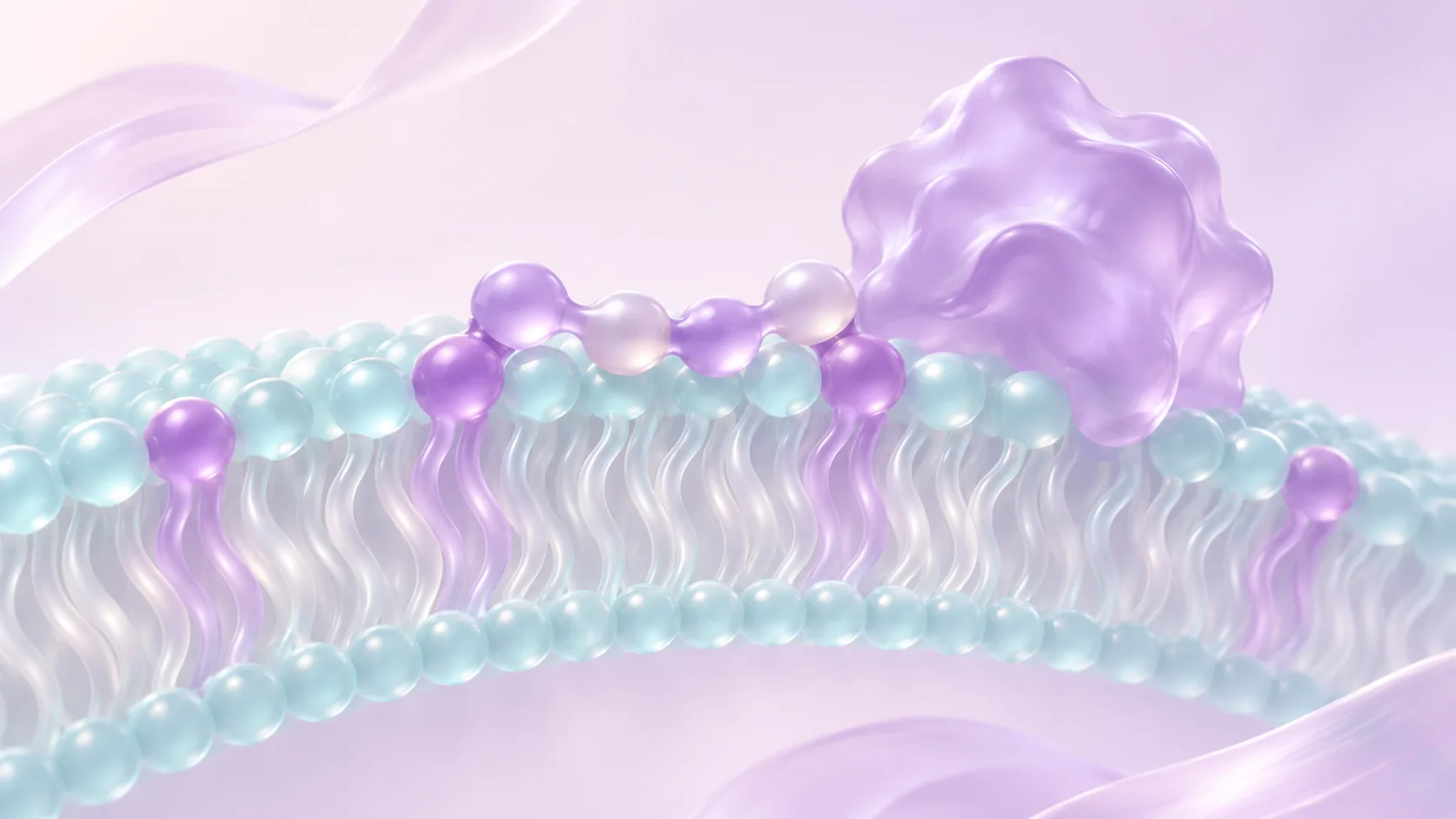
What would a membrane have to contain for SS-31 to bind?
Picture two model membranes. One contains a lipid called phosphatidylcholine. The other includes cardiolipin. If a peptide gives a detectable binding signal in the second preparation, cardiolipin deserves attention. To find out how much of the difference depends on cardiolipin itself, though, you would want to know how the peptide behaves in more than those two mixtures.
That is a useful starting point for the SS-31 literature. SS-31, also called elamipretide, is a tetrapeptide, a chain of four amino acid residues. Birk and colleagues examined its interactions with lipid preparations, cytochrome c and isolated mitochondria. The study moves across those preparations because a membrane interaction and an organelle’s oxygen use take different measurements to observe.
Three levels of experiment in the early paper
The 2014 paper used model lipid preparations to compare phosphatidylcholine alone with mixtures containing cardiolipin. Fluorescence, turbidity and nuclear magnetic resonance offered different views of the peptide–lipid interaction. These approaches do not all sense the same feature. A fluorescence signal can reflect the local environment of a molecule, while a turbidity measurement tracks how the preparation scatters light.
Then the researchers moved to a question about cytochrome c, an electron-transfer protein. In experiments with added cardiolipin, the authors reported that SS-31 restored cytochrome c reduction and mitochondrial oxygen consumption under their respective test conditions. These figures shift the question from association with lipids to the measured behaviour of a protein or isolated organelle.
When the preparations change between panels, keep that visible in the notes. The model lipid preparation lets you see what happens in a simplified membrane. The mitochondria contain many other components, which is useful for observing the output of the whole organelle and makes it harder to assign that output to one interaction.
A later comparison changes which lipid carries the charge
In 2020, Wayne Mitchell and colleagues tested more than one type of negatively charged lipid. The study included membranes with phosphatidylglycerol, which gave them a charged comparison without cardiolipin. They observed binding there too, with the measured association depending on the composition and charge of the bilayers they tested.
Now return to the two preparations in the opening. Adding cardiolipin changes the molecule present and the electrostatic properties of the surface. A comparison with another anionic lipid helps separate those explanations. The finding that binding persists in a cardiolipin-free mixture leaves room for cardiolipin-rich membranes to show stronger binding under the conditions tested. Both features belong in an account of the later results.
How to read a proposed mechanism one step at a time
The 2020 team also examined surface electrostatics and calcium near the membrane interface. Think of this as a question about the local environment that a membrane-associated protein encounters. It has a different readout from the binding experiment. The authors used these observations to propose ways an interaction with the bilayer might influence nearby processes.
A mechanism figure often packs several experiments into a few arrows. Pick an arrow and ask what was actually measured on either side. For an arrow from peptide association to altered surface charge, look for independent information about both features. For an arrow continuing to a change in a protein, look for an assay of that protein. There is a difference between a measured connection and a connection the authors propose because it could explain their results. Keeping both visible makes the diagram easier to discuss.
Four related peptides make for a sharper comparison
The 2022 paper compared SS-31 with three other tetrapeptides. The researchers varied the arrangement and identities of certain side chains, then looked at structure, membrane behaviour and selected cellular readouts. They used nuclear magnetic resonance and molecular dynamics for structural information. The tested analogues differed in their effect on membrane surface charge, even though they shared the same residue count.
The comparison narrows a broad question about how chemistry relates to function. Its coverage is the four molecules and measurements in the paper. It does not chart every possible sequence. The comparisons include measurements in model membranes and experiments with isolated mitochondria or cultured cells. Check the preparation when choosing a figure that addresses a particular property.
When you take a result from this experiment into a literature summary, carry the exact analogue and readout together. One compound can give a larger change in a selected membrane measurement without that ordering carrying over to every other endpoint.
A short way to compare the three papers
Write the sample at the top of each page of notes. If it is a synthetic membrane, list the lipid comparison. If it is an isolated organelle, write the particular output measured. If it is a group of related peptides, list the compounds and the chemical difference the authors were trying to examine.
Next, write one sentence per result and underline the verb. If you chose 'binds', look for the binding evidence. If you chose 'changes oxygen consumption', look for the respiration experiment and its comparison. Once the verbs line up with the figures, you can explain how the studies connect while retaining the models and the limits of each result. Use lot-specific analytical documentation for a material from a different source.
Study disclosures
Birk and colleagues disclosed licensing to Stealth Peptides and financial interests for two authors and the Cornell Research Foundation. The 2020 and 2022 papers disclose Hazel H. Szeto’s financial interests in Stealth Biotherapeutics. The 2022 disclosure also identifies a pending patent related to two of the analogues, assigned to Social Profit Network.
Sources: Birk and colleagues, British Journal of Pharmacology (2014): Targeting mitochondrial cardiolipin and the cytochrome c/cardiolipin complex to promote electron transport and optimize mitochondrial ATP synthesis · Mitchell and colleagues, Journal of Biological Chemistry (2020): The mitochondria-targeted peptide SS-31 binds lipid bilayers and modulates surface electrostatics as a key component of its mechanism of action · Mitchell and colleagues, eLife (2022): Structure-activity relationships of mitochondria-targeted tetrapeptide pharmacological compounds
Frequently asked questions
Is cardiolipin required for every measured SS-31 membrane interaction?
Mitchell and colleagues observed binding in model membranes made with phosphatidylglycerol as the anionic lipid, without cardiolipin. The result is about the tested bilayers. Composition still matters when comparing how strongly the peptide associates with different membranes.
What is a model membrane?
It is a preparation made from selected lipids. In these papers, controlling which lipids are present lets researchers ask what changes when a particular component is included or replaced. An isolated mitochondrion provides a different level of evidence with more of the native components present.
Sources: Birk and colleagues, British Journal of Pharmacology (2014): Targeting mitochondrial cardiolipin and the cytochrome c/cardiolipin complex to promote electron transport and optimize mitochondrial ATP synthesis · Mitchell and colleagues, Journal of Biological Chemistry (2020): The mitochondria-targeted peptide SS-31 binds lipid bilayers and modulates surface electrostatics as a key component of its mechanism of action
Why look at cytochrome c separately?
Cytochrome c is a protein involved in electron transfer. A test of its reduction asks how that protein behaves in the specified preparation. Measurements of peptide binding to a lipid mixture and oxygen consumption by mitochondria provide complementary information.
What makes four tetrapeptides a useful comparison?
They give the researchers a defined set of chemical differences to examine alongside their measurements. In the 2022 study the side chains and their arrangement differed within the set, so the authors could examine how those differences related to membrane properties.
Sources
- Targeting mitochondrial cardiolipin and the cytochrome c/cardiolipin complex to promote electron transport and optimize mitochondrial ATP synthesisBirk and colleagues, British Journal of Pharmacology · 2014 · DOI: 10.1111/bph.12468
- The mitochondria-targeted peptide SS-31 binds lipid bilayers and modulates surface electrostatics as a key component of its mechanism of actionMitchell and colleagues, Journal of Biological Chemistry · 2020 · DOI: 10.1074/jbc.RA119.012094
- Structure-activity relationships of mitochondria-targeted tetrapeptide pharmacological compoundsMitchell and colleagues, eLife · 2022 · DOI: 10.7554/eLife.75531
Published by EliteGen Research for research education. Studies describe their own materials and experimental conditions; they do not establish the identity, quality, or suitability of an EliteGen product. This article does not provide guidance for personal, human, or veterinary use.